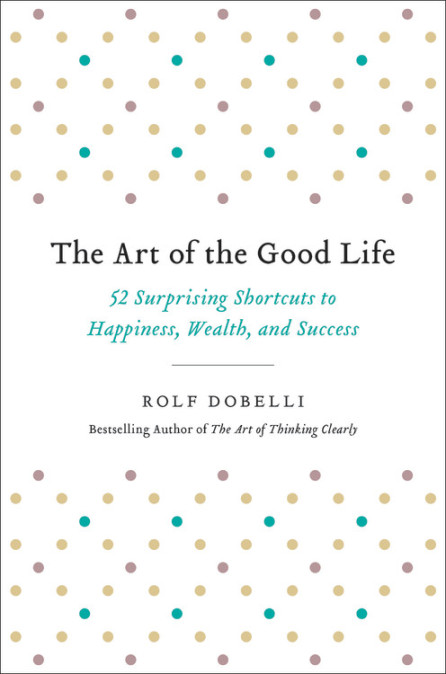
What exited me about this book are the words on its back cover. Let me read it for you.
“Have you ever…
- Spent too long on a PowerPoint presentation?
- Lost sight of what makes you happy?
- Failed to reach a long-term goal?
- Become infuriated by queuing, tax or parking tickets?
- Broken a promise you knew you’d keep?
Since the dawn of civilization, we’ve been asking ourselves what it means to live a good life: how should I live, what will truly make be happy, how much should I earn, how should I spend my time? In the absence of a single simple answer, what we need is a toolkit of mental models, a guide to practical living.
In ‘The Art of the Good Life’, you’ll find fifty-two intellectual shortcuts for wiser thinking and better decisions, at home and at work. They may not guarantee you a good life, but they’ll give you a better chance.”
I am still reading it but the chapters I’ve read till now are really amazing. I’ll share with you some of the chapters so that you can decide whether you’ll like to read this book or not.
- First chapter “Mental Accounting” explains beautifully that we should interpret facts in constructive way. Do you hate queuing at supermarket or waiting at traffic signal? Your blood pressure reaches 150 in seconds. But instead of getting upset, you could think it in a positive way that without this unnecessary agitation, you’ll live a whole year longer. That’s more than you would lose while waiting. This way you could enjoy every moment of your life making it a good life. This chapter topic best describes it. “How to turn a Loss into Win”
- Next great chapter is “Black Box Thinking”. The chapter starts with an interesting case study. In 1953 and 1954, number of mysterious airplane accidents took place. Pilots died in all of these accidents, so aviation industry was not able to figured out the flaw. Eventually the flaw was identified. After that disaster, accident investigator suggested that they should install flight data recorder in each and every jetliner. This recorder was later named Black Box. After a spectacular emergency landing, Captain Sullenberger wrote “Everything we know in aviation, every rule in the rule book, every procedure we have, we know because someone somewhere died.” With each crash, future flights become safer. So, Black Bok Thinking is a mental tool that records our mistakes so that next time we don’t make that mistake. By using Black Box Thinking tool, every false step we make can improve our future life.
- For last example, I’ll start by a question that Dobelli asked in the chapter. “What proportion of your success would you credit to your own achievement?” Now, hold on to your answer. Just add these facts to your decision. You were born in a particular nation with a particular postcode into a particular family. None of that is within your control. Then, you have been given values, behaviours and principles that help you everyday and again, these are beyond your control. You were placed into an education system with teachers you didn’t choose. You make everyday decisions based on what? Perhaps you read a book that changed your life or you heard it somewhere or you met somebody, without which you wouldn’t have got where you are today. Six percent humans who have ever lived on Earth are alive at this moment. Imagine yourself born during World wars or during the period where Dinosaurs existed. So now answer the question: “What proportion of your success would you credit to your own achievement?” The logical answer is zero. Your success is based on things over which you have no control. So, for living a happy life, stay humble. Remind yourself daily that everything you are, everything you have and everything you can do, is a result of blind chance. For us, who are blessed with good luck, help people who were born with wrong genes in areas with wrong postcodes.